Ang Thong National Marine Park at a Glance
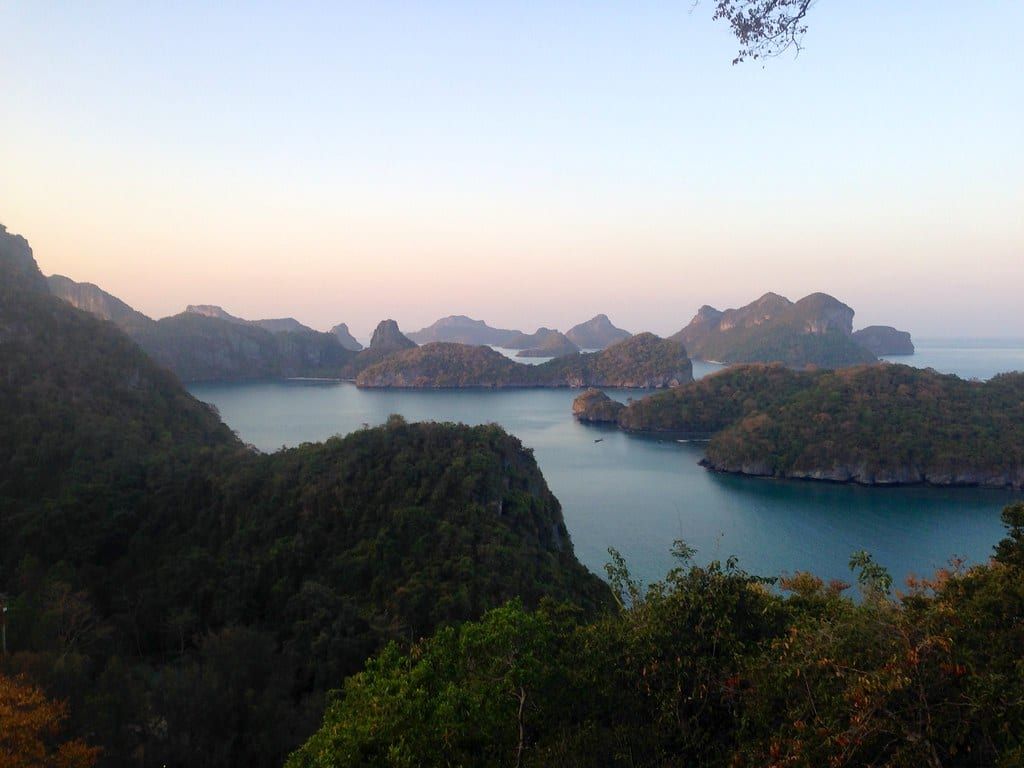
Ang Thong delivers more per square mile than almost any day trip in the Gulf of Thailand. You leave Koh Samui in the morning, and by lunch you have stood above a collapsed lagoon, paddled a sea cave, and photographed 42 jungle-topped islands from a cliff.
The archipelago sits about 28-30 km northwest of Koh Samui, 42 limestone karst islands scattered across roughly 102 square kilometres of sea. Most of that area is water; only 18-19 square kilometres is land. Established on 12 November 1980, Mu Ko Ang Thong is one of Thailand's earliest marine protected areas, and since 2002 it has also been a Ramsar Wetland of International Importance. The name means golden bowl.
Its fame has three sources. The panoramas from the Wua Ta Lap viewpoint, the inland lagoon of Thale Nai, and Alex Garland, who set his novel The Beach here after kayaking the islands (the 2000 film shot its beach scenes at Maya Bay in the Phi Phi Islands instead). Garland also gave the park an endemic flower: the Ang Thong lady's slipper orchid grows here and nowhere else on earth.
Almost everyone arrives from Koh Samui. Koh Phangan sits slightly closer, runs shorter crossings, and works just as well, while Koh Tao-based trips exist but are rarer thanks to the 55 km distance. There is no public ferry and no walk-up entry. Licensed tours only.
What follows is every real activity in the park, what each one costs you in sweat and hours, and which boats deliver what.
Hike to the Wua Ta Lap Viewpoint
The trail from Wua Ta Lap's park headquarters climbs just 500 m, but it gains roughly 400 m, and most of it is stepped or rope-hauled stone. Signage at the top names the summit Pha Jun Jaras, sometimes written Pha Chan Charat; tour brochures just say the Ang Thong viewpoint. One spot, three names.
Five platforms break up the climb at roughly 100 m, 200 m, 350 m, 450 m and 500 m. The early trail runs under tree cover; the top half is fully exposed, and most tours reach the island around midday, which is exactly when that stops being fun. Count on 30-45 minutes up and the same down, in heat that flattens people who jog at home. From the top deck you look across dozens of islands stacked to the horizon, the shot every Ang Thong tour uses in its advertising.
About 30 percent of visitors skip the summit entirely, and they are not wrong. The 350 m platform already gives you the panorama; the two stages above it add sweat more than scenery. Turn around there if your knees object, if you are hiking with small children, or if the boat leaves in under an hour and you still owe yourself a swim.
If you skip it: the beach at Wua Ta Lap is 200 m from the trailhead, the water is calm, and nobody is taking attendance. Take two litres of water and shoes with grip either way; flip-flops on wet stone are how most injuries here happen.
See Emerald Lake (Thale Nai) on Koh Mae Ko
Thale Nai is a circular saltwater lake sitting inside a collapsed limestone crater on Koh Mae Ko, connected to the sea through underwater caves, which is what keeps the water moving and the color shifting between jade and emerald as the light changes. Tour listings call it Emerald Lake, Blue Lagoon, or Green Lake. Same crater.
Reaching it takes a 10-15 minute stair climb from the beach, some steps steep enough to count as ladders. It is far easier than the Wua Ta Lap hike, and older visitors who skip the summit handle this one without trouble. Two viewing decks wait at the top; a lower platform closer to the waterline is the better photo angle.
Swimming is strictly forbidden, and the rule has teeth: the lagoon's ecosystem is fragile and the lake is effectively enclosed. You look, you photograph, you descend. Budget 20-30 minutes on the island in total. Midday is when the platforms jam up, as boats arrive together; if you are on an early or late schedule, you get the deck nearly alone.
Kayak Through the Limestone Channels
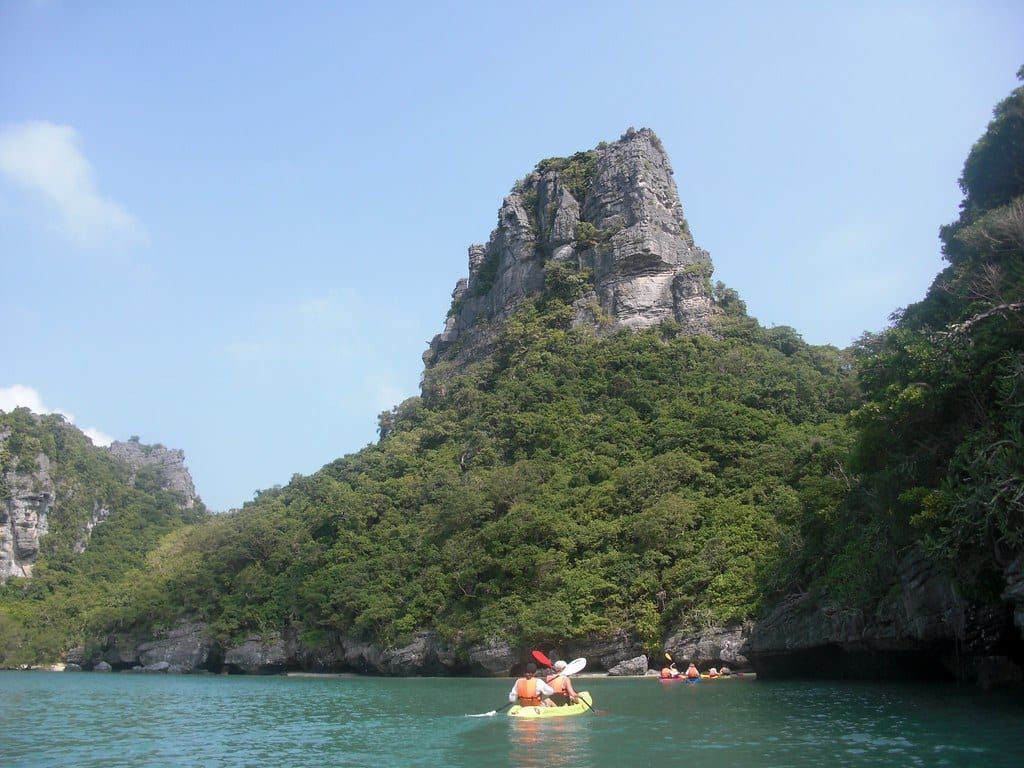
Kayaking gets you under scenery no trail reaches: narrow channels between 100-metre cliffs, natural rock arches, sea caves with skylight openings, and one cave exit so low that you lie flat in the kayak to slide through. Sessions run 40-60 minutes along sheltered coastline with a guide, never open water. The kayaks are sit-on-tops, life jackets come in every size including children's, and the routes are beginner-safe, pairs as young as four or five ride in doubles with an adult.
The booking catch decides your day. Speedboat tours include kayaking in the ticket, usually launching from Wua Ta Lap. Big boats sell it as an add-on at around 250 baht per person, typically at Koh Mae Ko. Sailing cruises do not offer it at all. If paddling matters to you, check the inclusions before paying, our speedboat tours list which trips bundle it.
No-kayak alternative: the same stop offers snorkeling or beach time, and you choose when booking, not on the boat. Langurs and sea eagles work the cliff lines here, so keep one eye off the paddle. And bring a dry bag or waterproof pouch; this is the activity your phone will regret.
Snorkel and Dive the Reefs
Straight answer first: the reefs inside the park are tired. Decades of tour traffic, sediment from the nearby Tapi River, and an average water depth of about 10 m add up to visibility of 3-5 m on a good day, against 15-20 m at Koh Tao. Come for the karst scenery and treat the snorkeling as a pleasant break, not the point of the trip.
The best stop is Koh Wao, a small island group just outside the main park boundary where the water is typically clearest. Koh Sam Sao and Koh Mae fill out the schedule. The surprise at Koh Wao is sea-cave snorkeling, swimming into caves hung with giant purple sea sponges and past coral gardens of anemones, clownfish and butterflyfish. Snorkelers are required to wear or carry a life jacket there so other boats can see them. Do it.
Diving is the park's quiet overperformer. Visibility runs 5-30 m, sites are diveable year-round, and the shallow water and marine tunnels hold barracudas, fusilier schools, cuttlefish, sea snakes and nudibranchs. Some day trips from Koh Samui add a dive; dedicated divers should compare this with a Koh Tao day instead, since the water there is clearer more often.
Beach Time and Scenic Cruising
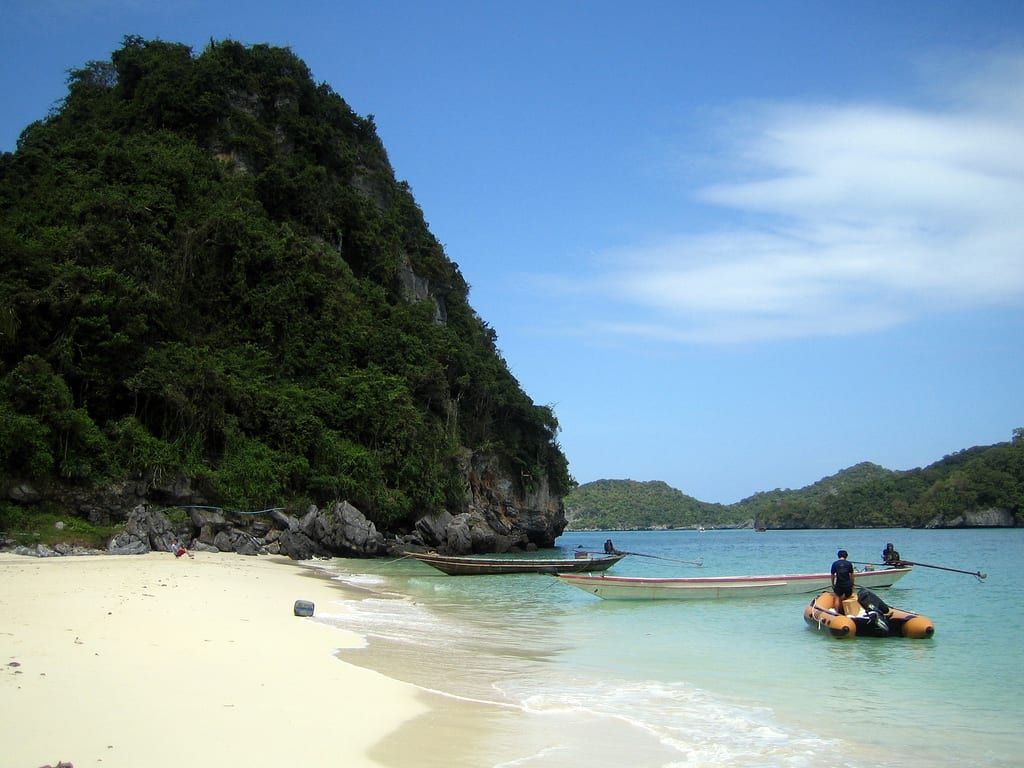
Wua Ta Lap has two white-sand beaches: one beside the visitor center, and a second reached on a 700 m forest walk to the island's west side. The first is the postcard, the one on every tour brochure, and usually where lunch happens, either a hot buffet on board or a beach barbecue depending on the operator. Both swim calmly.
Koh Sam Sao pairs a quieter beach with a natural rock arch you can walk under, and it is the stop most itineraries treat as a breather. Mae Ko's small beach sits right at the foot of the Emerald Lake trail, a quick cool-down after the stairs, with rocks scattered in the shallows, so enter the water slowly.
Then there is the crossing itself, which nobody lists as an activity and everybody photographs. Steep green towers pass close enough to read the geology; dolphins occasionally bow-ride the boat. On the run home the low sun flattens the sea and the islands go silhouetted one after another. Pick a seat on the upper deck for it.
Spot Wildlife on the Trails and Cliffs
Dusky leaf monkeys, with white-ringed eyes like spectacles, work the forested trails and the shoreline near the ranger station on Wua Ta Lap, and long-tailed macaques hold territory nearby. Birds are the most reliable sightings: over 50 species are recorded across the archipelago, including white-bellied sea eagles riding the cliff updrafts and collared kingfishers on the beaches. Scan the ridge lines mid-morning, when the thermals lift the raptors.
A warning on advertising: some tours promote a wild monkey island stop, and it gets skipped more often than it runs, usually for time or weather. Do not book a trip on the strength of it.
Explore Bua Bok Cave and the Park Trails
Bua Bok Cave sits about 1 km from Wua Ta Lap headquarters, reachable on a forest path that turns rocky near the entrance. Inside are stalagmites, stalactites and lotus-shaped flowstone, the formations that gave the cave its name. Headlamp or torch, closed shoes, and an hour round trip; it is the only significant cave most day trips skip, which makes it the quietest walk on the island.
The cave and the western beach share the same trailhead area, so overnight guests can fold both into one late-afternoon loop once the day-trippers have gone.
Stay Overnight: Camping and Bungalows
Sleeping in the park is the activity almost nobody takes, and it is the one nobody forgets. After the last boat clears out around 4 pm, Ang Thong goes quiet, and you get the beaches, the viewpoints and the stars to yourself until the first speedboat returns the next morning.
Accommodation is on Wua Ta Lap only: a campground and a handful of simple bungalows. Camping costs 80 baht per person per night, with tents rentable for 450 baht; bungalows run 600 baht for a two-person unit and 1,500 baht for an eight-person one. Book direct with the Department of National Parks through its reservation site, dnp.go.th, and book early, the bungalow count is tiny. Fair warning: the DNP booking system has had long outages, so save the park office number (077 286 588) as a fallback, and call with a Thai speaker if you can.
There is a trick worth knowing. Big-boat tickets allow a two-day split at no extra charge, you sail out one day and return on a later departure, while speedboat tours run day trips only. The catch: the return seat for overnight guests costs about 1,000 baht per person, because the operator holds a chair for you. Organize that pickup in advance, not the morning you want to leave. Facilities are basic, there is no ATM, and the island's single restaurant closes at 3 pm and reopens 6-8 pm, so carry cash, a torch, snacks and repellent.
Planning Your Visit: Tours, Costs, Timing and Rules
Every visit runs through a licensed tour operator; there is no ferry and no independent access. Here is how the options actually compare, what the day looks like, and the details that catch people out.
Which boat to book
Three formats cover the market, and the choice changes your whole day, not just your seat. The table below pulls together current per-person price ranges across multiple operators, not one company's list.
| Boat type | Price range (THB) | Crossing time | Trade-off |
|---|---|---|---|
| Big boat | 890-1,200 | 90-120 min | Cheapest and most stable; least park time; kayaking costs 250 extra |
| Speedboat | 1,740-1,900 | 45-60 min | Most park time, smaller groups; choppy; kayaking included |
| Sailing cruise | 3,400-4,690 | 90-120 min | Comfortable and slow; no kayaking |
| Private charter | From ~32,850 per boat | 45-60 min | Custom itinerary, up to 40 people, avoids crowds |
Families with small children and anyone who gets seasick: take the big boat. Travelers who want maximum time on the islands and the kayak session thrown in: speedboat. The sailing cruise suits couples who want the crossing to be the point. Koh Phangan departures price at roughly the same level as Samui's, on a similar or slightly shorter crossing, and our tours from Koh Phangan page covers those departures.
Fees, hours and the annual closure
Entry costs 300 baht for foreign adults and 150 baht for children aged 3-14, paid in cash at the park; Thai nationals pay less. It is almost never inside the tour price, so confirm before you book and carry the money on the day. The park opens daily 8 am to 5 pm.
Every year the park shuts for monsoon recovery, normally 1 November to 15 December, with the reopening date shifting with the weather (usually between 10 and 20 December). October is open but wet, windy and cancellation-prone. The prime window is January to April for calm seas and the clearest water; May to September is a solid shoulder with thinner crowds. Book one to two weeks ahead in the December-February peak.
Full fee, hours and closure details are on our hours and fees page, updated when the park announces dates.
What a day actually looks like
Hotel pickup runs 7:30-9:20 am, followed by a crossing of 45 minutes to two hours depending on your boat. A typical order: snorkeling stop at Koh Wao, lunch on board or at the Wua Ta Lap beach, kayaking, then the Koh Mae Ko lagoon or the viewpoint, and the cruise back, docking by 5-6 pm. Speedboats run it in the same order but faster between stops, which is how they buy you an extra activity. One reliable gotcha from first-hand reports: confirm your actual pickup time, not the listed tour start time, with the operator the day before. One traveler's shuttle arrived 90 minutes earlier than expected, and he nearly missed the boat.
Rules, packing and seasickness
The park enforces three rules that surprise people. Single-use plastic is banned, and your bottle may be held on the boat. Chemical sunscreens with oxybenzone or octinoxate are restricted under Thai regulation, so bring mineral sunscreen. And drones need a written permit from the Department of National Parks, enforcement is strict, and unauthorized flights risk fines up to 100,000 baht plus confiscation. Leave the drone home.
- Shoes with grip; flip-flops fail on the trails
- Swimwear worn under clothes
- Reef-safe mineral sunscreen
- Dry bag or waterproof phone pouch
- 2+ litres of water for the viewpoint
- 300 baht cash for the park fee, plus more for extras
On seasickness: on rough days roughly 20-30 percent of speedboat passengers feel it. Take a tablet 45-60 minutes before pickup, eat a light breakfast, and sit mid-boat. If the forecast looks lively, the big boat is the stable choice, and operators cancel when waves top about 1.2 m or winds cross 25 knots, with a full refund or free reschedule as standard. Booking is straightforward through established operators; skip beach touts and anything suspiciously under 1,200 baht. Our Ang Thong tours overview compares the current options side by side, and the getting there page covers piers and routes.
Who should skip the park
If reef quality is your top priority, go to Koh Tao instead, its 15-20 m visibility wins that contest outright. If steep stairs are off the table, you can still do the beach, the boat and gentle kayaking, but know that the viewpoint and lagoon decks are stair-only and the park is not wheelchair accessible. And if the idea of a nine-hour day trip makes you tired, this is not your trip; the crossing alone can eat four hours round trip. Everyone else, and that includes most families and plenty of seniors, will get a day they photograph for years. First-time visitors should read the day trip planning guide before booking.
Frequently asked questions
Is Ang Thong National Marine Park worth visiting?
Yes, if scenery, kayaking, the viewpoint and photography are what you want; the karst panorama is one of the best in Thailand. No, if quality snorkeling is the priority, the in-park reefs are degraded with 3-5 m visibility against 15-20 m at Koh Tao.
How much does a day trip to Ang Thong cost?
Tours run from about 890-1,200 baht on a big boat, 1,740-1,900 baht by speedboat, and 3,400-4,690 baht on a sailing cruise. Add the 300 baht adult park fee in cash, usually excluded from the ticket, and 250 baht for kayaking on big-boat trips.
When is Ang Thong National Marine Park closed, and when is the best time to visit?
The park closes annually from 1 November to about 15 December for monsoon recovery, with the reopening date shifting slightly each year. Best conditions run January to April; May to September is a good shoulder season; October is wet and cancellation-prone.
Can you swim in Emerald Lake (Thale Nai)?
No. Swimming in the lagoon is strictly forbidden to protect the enclosed ecosystem. You view it from wooden platforms reached by a 10-15 minute stair climb from the beach on Koh Mae Ko.
How hard is the Wua Ta Lap viewpoint hike?
The trail is only 500 m but gains about 400 m over steep stone steps with rope handrails, taking 30-45 minutes each way in humid heat. Around 30 percent of visitors skip the summit; the 350 m platform gives a panorama that is nearly as good.
Can you stay overnight in Ang Thong National Marine Park?
Yes. Camping on Wua Ta Lap costs 80 baht per person plus about 450 baht tent rental, and simple bungalows run 600-1,500 baht, booked direct with the Department of National Parks. Big-boat tickets allow a two-day split, and the return seat costs about 1,000 baht per person.
Is Ang Thong suitable for kids or people who cannot hike?
Largely yes. Kayaking works for children from four or five in a double with an adult, beaches are calm, and the Emerald Lake stairs are manageable for moderately fit seniors. Skip the viewpoint summit with young children or mobility issues, and take a big boat for stability.
Will I get seasick on the way to Ang Thong?
Possibly, on rough days about 20-30 percent of speedboat passengers do. The crossing is 45-60 minutes by speedboat or 90-120 by big boat. Take a tablet 45-60 minutes before pickup, eat light, sit mid-boat, or book the big boat, which is the most stable option.