Kayaking is the point of Ang Thong. Forty-two limestone islands stand in the Gulf of Thailand about 30 km northwest of Koh Samui, and the best of what they hold — sea caves, rock arches, channels too narrow for any boat with an engine — sits just above the waterline. A paddle puts you there. Nearly everyone visits on a day tour, nearly every tour includes kayaking, and the catch is that standard trips give you 40–60 minutes of it.
Here's where you actually paddle, which trip buys the most kayak time, what the day costs once the fees stack up, and the only way onto the water without a tour group around you.
Why Ang Thong Is One of Thailand's Best Sea Kayaking Destinations
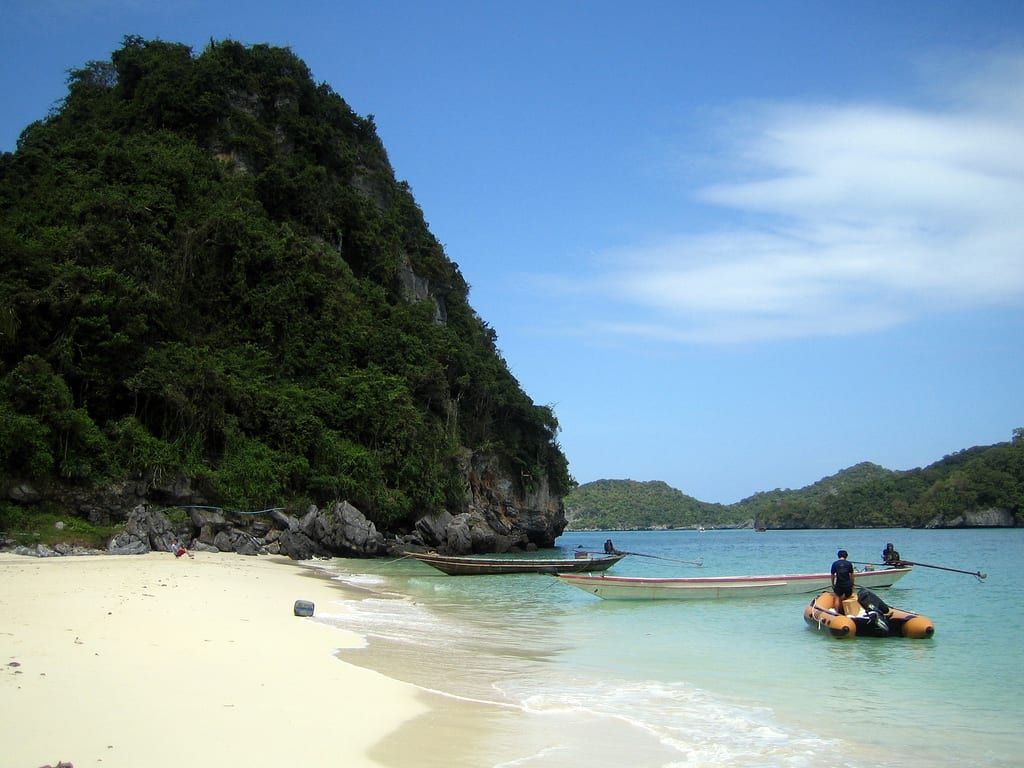
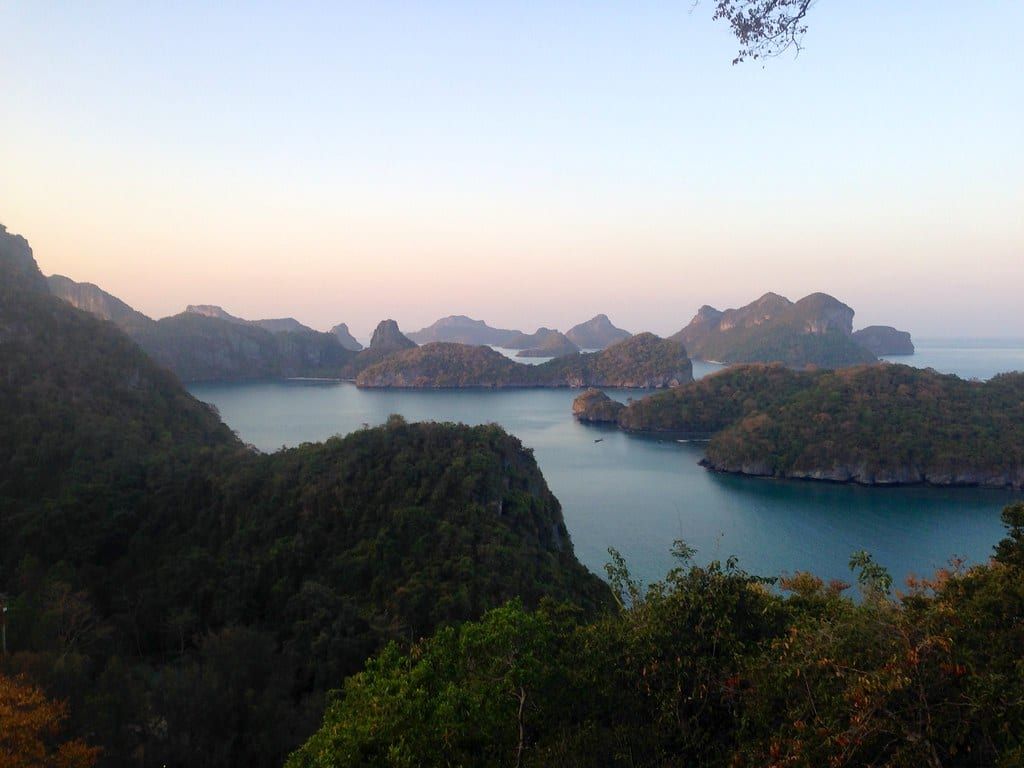
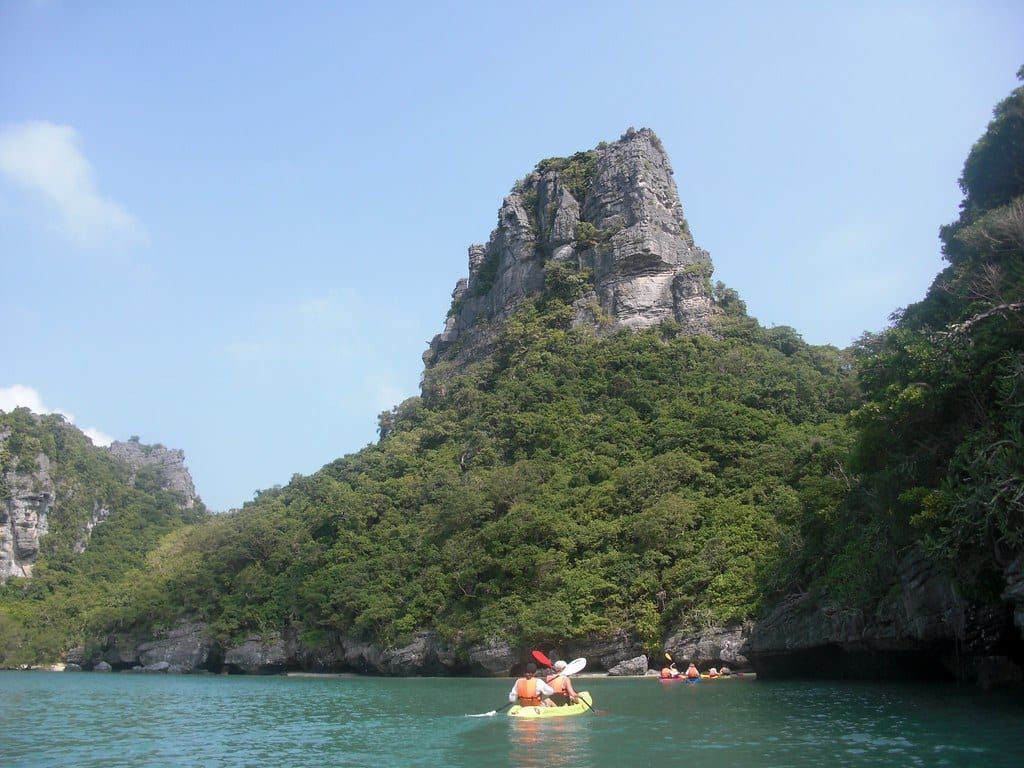
Mu Ko Ang Thong became a national park on 12 November 1980, among the first of Thailand's marine protected areas. It spans roughly 102 km², nearly all of it sea — the 42 islands hold barely 19 km² of land between them — and in 2002 the Ramsar Convention listed the archipelago as a wetland of international importance. The highest karst, on Koh Phaluai, rises 396 m straight out of the water. From a kayak, that geometry is the whole show: cliff bases you can touch with a paddle blade, overhangs, tunnels and collapsed-cave lagoons no longtail can reach.
Snorkeling is the weaker half of any day here. Average depth runs about 10 m, and sediment drifting out of the nearby Tapi River keeps visibility ordinary. The scenery sits above the waterline — so paddle first and snorkel with whatever time is left.
A literary footnote follows the park around: the archipelago inspired Alex Garland's novel The Beach, though the 2000 film shot its beach scenes on Koh Phi Phi. The mix-up works in your favor. Ang Thong logged about 134,000 visitors in 2019 — a single busy afternoon at Maya Bay.
So the decision is between a general island-hopping tour with a 40–60 minute kayak slot and a kayak-focused trip built around paddling. Both run from Koh Samui and Koh Phangan and hit the same famous stops; they differ in hours on the water. For everything off the kayak — the dry cave, beaches, hikes — our guide to things to do in the park fills the gaps.
Where You Actually Paddle: Islands, Channels, Caves and Lagoons
Nearly all the paddling happens inside the archipelago, where karst walls break the wind and the water sits flat. Island by island, here's the map.
Koh Wua Talap: Where Every Paddle Starts
Koh Wua Talap is park headquarters, and its beach is where nearly every tour launches tandem sit-on-top kayaks. Routes hug the cliff bases on the island's sheltered side and slip into narrow sea passages and shallow lagoons between the karsts. First-timers spend the opening minutes steering with their hands. It doesn't matter — the water is calm and often waist-deep. Overnight guests launch from this same sand.
The Sea Caves: Skylights and Lie-Flat Exits
The cave is what people remember. You paddle into a chamber lit through a skylight in the rock, then out through an exit so low you lie flat on the deck and haul yourself along by the walls. After that come the arches: short tunnels under natural rock bridges, with cliff close enough on both sides that you steer by leaning. A session like this runs about 40 minutes on a big-boat tour; which caves you get depends on the operator's route and that day's wind.
Koh Sam Sao and Its Stone Arch
Koh Sam Sao has two beaches, Ao Hin Kong and Ao Wangkong, and a natural stone arch at its northern tip you can paddle right up to. It's the island where kayaking and snorkeling pair best: paddle the arch, then swim off the sand. Boats with flexible itineraries are the ones that stop — usually the smaller groups.
The Far North Around Koh Tai Plao
The best paddling is the most remote. Around Koh Tai Plao in the park's far north you get rock overhangs, tunnels, small caves and a hidden lagoon — and almost nobody else, because only small kayak-specialist operators route this far up. Blue Stars, the operator most associated with the area, says its trip is normally the only one visiting. That solitude is the product, and it's why specialists cost more.
Emerald Lagoon (Talay Nai): Look, Don't Paddle
One name needs untangling. Thale Nai, the Emerald Lagoon, is a jade-green saltwater lake inside Koh Mae Ko, connected to the sea through underwater caves. You can't paddle it and you can't swim in it — swimming is prohibited. It's a staircase viewpoint, reached on a roughly 20-minute walk up from the beach, and a hiking stop on the itinerary rather than a kayaking one. Some routes paddle Koh Mae Ko's outer coastline; the lagoon itself stays view-only.
What a Kayak Tour Day Looks Like, Hour by Hour
Days start early and follow a fixed pattern. Hotel pickups fall between 7:30 and 8:00 am, then a minibus to the pier — speedboats leave from Mae Nam or Nathon on Samui, big boats from Nathon. The crossing covers 28–30 km: 45–60 minutes by speedboat, 90–120 by big boat. Day tours from Koh Samui dominate, but tours from Koh Phangan follow the same schedule from about 35 km out. For a stop-by-stop breakdown, see the full Ang Thong day trip guide.
In the park, the day rotates through three or four stops — the viewpoint or beach on Koh Wua Talap, the Emerald Lagoon stairs on Koh Mae Ko, a kayak-and-snorkel session, and lunch, hot and on deck on the big boats. Operators running two groups split the water time: group one kayaks while group two snorkels, then they swap. Ask for the first kayak group. You paddle on flatter water before the wind builds, and you spend your second slot on snorkeling, the day's weaker half, rather than the reverse.
The Pha Jun Jaras viewpoint above headquarters is the day's hardest stretch: a 500–550 m rope-assisted trail gaining about 400 m, rocky and sweaty, 25–45 minutes each way. The panorama over the archipelago pays for it. Around 30% of guests skip the climb and stay on the beach — a fair call in midday heat. Non-climbers can walk the 1 km trail to Bua Bok Cave instead, a dry cave of stalactites and lotus-shaped flowstone.
Choosing Your Trip: Kayak-Focused Tours vs Speedboat vs Big Boat
Judged on paddling alone, the formats rank cleanly: kayak-specialist small groups first, VIP speedboats second, big boats third, sailing cruises a style choice rather than a paddling one.
| Format | Typical price | Group size | Crossing | The paddling |
|---|---|---|---|---|
| Big boat | from ~฿1,200 | 50–70 | 90–120 min | Fixed ~40-minute slot; queue for kayaks |
| VIP speedboat | ฿1,550–1,850 | 20–30 | 45–60 min | Longer stop, fewer kayaks to share |
| Kayak specialist | ~฿2,200 all-in | Small group | Longer, to the far north | Most paddle time; caves near Koh Tai Plao |
| Sailing cruise | ~฿3,400 | Varies | Slowest | Kayaking is one stop on a sailing day |
So which trip? If paddle time is the priority, book the kayak specialist: a Blue Stars-style day runs around ฿2,200 with hotel transfers, breakfast, lunch, gear and all entrance fees rolled in, and it routes to the overhangs and tunnels of the far north. Speedboats are the middle path — 20–30 passengers and an extra hour in the park; our speedboat tours page lists what's running. Big boats are the budget and the seasickness answer, 50–70 people on a hull that barely rolls, and you can compare boat tours to find the emptier departures.
Private speedboat charters start around ฿30,000–32,850 per boat for up to 40 people — split across a big family group the math works, and you decide how long the kayak stop lasts. Sailing cruises at about ฿3,400 are for travelers who want the crossing itself.
Two notes finish the money picture. When an itinerary offers a kayak-or-snorkel slot, take the kayak: at roughly 10 m average depth with Tapi River sediment in the water, the reefs are the park's weakest feature. And the full stack is tour price plus the ฿300 foreign-adult park fee (฿150 children 3–14; ฿40/20 for Thais), paid in cash and excluded from most prices, plus a possible ~฿400 round-trip surcharge for remote pickups such as Lipa Noi or Thong Nai Pan. Some beaches get no pickup at all — check before booking.
Kayaking Ang Thong Without a Join-In Tour: Rentals, Camping and Overnights
You can't DIY the day trip. There's no public ferry and no regular boat service — access is limited to licensed tours and private charters, nearly all from Koh Samui and Koh Phangan, with a handful of operators making the ~55 km run from Koh Tao. Nothing departs Surat Thani. The workaround for independent-minded paddlers is to sleep inside the park.
Camping and Bungalows on Koh Wua Talap
Park headquarters rents tents and runs a few bungalows. Camping is ฿80 per person per night plus ฿450 for a two-person tent, sleeping bags, torches and mosquito net included; bungalows run ฿600 for two people and ฿1,500 for a unit sleeping eight. Book ahead — a couple of months ahead for bungalows in high season. The Department of National Parks' reservation site has had long outages, so the dependable route is phoning the park office on 077 286 588, ideally with a Thai speaker. Overnight packages from Koh Samui start around ฿1,550; the return leg costs about ฿1,000 per person, since the operator holds you a seat on a departing boat. Transport options are laid out in our guide to how to get to Ang Thong.
Paddling Outside Tour Hours
This is the payoff. A double or triple kayak rents on the beach for ฿500 a day, and from about 3:30 pm, when the day boats motor home, the water is empty. Early mornings are calmer still — glass before the wind rises, sea eagles instead of engines. Practicalities for the night: generator electricity runs 6–10 pm with solar by day, free wifi covers the restaurant area, meals there cost ฿60–120 and are served 8 am–3 pm and 6–8 pm, and there's no ATM, so carry cash.
How Hard Is It? Skill Level, Safety and Sea Conditions
No experience needed. Tours use stable tandem sit-on-tops, everyone wears a life jacket — child sizes included — and a guide paddles out front through sheltered water. Children from about age 4 ride as the second paddler with a parent. Non-swimmers join constantly; you're in shallow water near the cliffs and never far from the guide.
Tandem technique in one line: paddle in unison with your partner — opposite sides, matching rhythm — and steer less. In the caves you duck when told to, and at the low exits you lie flat and pull through. Follow the guide's exact line; the routes are chosen around the swell entering the cave mouths.
It is open water, though. When wind builds, operators shorten or reroute the paddle — one reviewer's trip lost most of its caves that way — and tours cancel outright at waves over 1.2 m, wind over 25 knots or lightning within 30 km. The call comes by 6 am, with a full refund or a free reschedule. Weather won't cost you money.
The crossing is where people suffer, not the kayaking. On rough days, 20–30% of speedboat passengers feel queasy. Take a tablet 45–60 minutes before pickup, eat light, sit mid-boat, keep your eyes on the horizon — or simply book the big boat. And remember the day's real physical test is the viewpoint climb, not the paddle.
Best Time of Year (and Day) for Calm Water
The Gulf of Thailand's calendar runs opposite to Phuket's. January to April is the calm, dry window — flat crossings, glassy lagoons. May to September works as a shoulder season with occasional afternoon showers. October turns rough, and by November the monsoon owns the sea.
Operators make the daily weather call by 6 am off the Thai Meteorological Department forecast, and a cancellation brings a full refund or free reschedule. Book 7–14 days ahead from December to February — kayak-specialist boats fill first — and 2–3 days is enough the rest of the year. If your dates sit near the shoulder, our park hours and fees page has the current schedule.
Within a day, mornings paddle best: lighter wind, flatter cave water, and the first kayak group out before the chop builds. That's the real argument for the 7:30 alarm. Overnight guests get a second window in the late-afternoon lull, once the last day boat has gone.
What to Bring and Park Rules Every Paddler Should Know
Kayak kit is short and specific. Everything below earns its place on the boat.
- Dry bag plus a waterproof phone pouch — kayaks splash, and occasionally tip
- Strap-on sandals or water shoes; flip-flops float away on the first wave
- Rash guard or light long-sleeve sun cover
- Mineral, zinc-based sunscreen — oxybenzone and octinoxate are restricted in Thai marine parks
- Motion-sickness tablets, taken 45–60 minutes before pickup
- Refillable bottle and cash for the park fee
Four park rules matter to paddlers. Swimming in Thale Nai is prohibited — the lagoon is strictly a viewpoint. Single-use plastics are banned, and bottles are sometimes made to stay on the boat, which is the refillable bottle's second job. Drones need written permission from the Department of National Parks; flying without one risks fines up to ฿100,000 and confiscation. And inside the caves, stay on the guide's line with the group tight. The standard conservation rules apply on top: nothing taken from the reef, nothing left on the sand.
Ang Thong Kayaking: Frequently Asked Questions
Is Ang Thong kayaking suitable for beginners?
Yes. Tours use tandem sit-on-top kayaks in sheltered water, with life jackets and a guide leading, for a session of roughly 40–60 minutes. The only technique that matters is paddling in unison with your partner — and ducking when the guide says duck.
How much does kayaking in Ang Thong Marine Park cost?
Join-in tours run roughly ฿1,200–2,200 per adult: big boats from about ฿1,200, VIP speedboats ฿1,550–1,850, kayak-specialist small-group trips around ฿2,200. The park entry fee — ฿300 adults, ฿150 children — is usually extra and paid in cash. On Koh Wua Talap, a double or triple kayak rents for ฿500 a day.
Where do you actually kayak in Ang Thong?
Around Koh Wua Talap's cliff bases and shallow lagoons, through sea caves with skylights and lie-flat exits, under rock arches and, on specialist trips, among the overhangs and hidden lagoon near Koh Tai Plao in the far north. The Emerald Lagoon on Koh Mae Ko is a staircase viewpoint, not a paddle.
Can you rent a kayak at Ang Thong and paddle on your own?
Not as a day visitor — there's no public ferry, so access is by licensed tour or charter from Koh Samui, Koh Phangan or Koh Tao. The workaround is an overnight on Koh Wua Talap, where kayaks rent for ฿500 a day and you can paddle before and after the day-trip crowds.
Is the kayaking better on a speedboat or big boat tour?
For paddling, speedboats win on group size (20–30 versus 50–70) and on time in the park, and kayak-specialist boats beat both. The big boat's case is stability and price: if you're prone to seasickness, a calmer hull is worth queuing for a kayak.
When is the best time of year for kayaking in Ang Thong?
January to April, when seas are calmest. May–September is a workable shoulder, and October crossings get rough. Avoid November and early December entirely — the park normally closes from 1 November to 15 December. Whatever the month, mornings have the flattest water.
Do you need to be able to swim to kayak in Ang Thong?
No. Everyone wears a life jacket, and the paddling happens in shallow, sheltered water close to the guide. The sterner test is the optional viewpoint climb — roughly 400 m of elevation on a rope-assisted trail that about 30% of guests skip.
Can children go kayaking in Ang Thong Marine Park?
Yes — children from about age 4 ride as the second paddler in a tandem with an adult, and child-size life jackets are standard. Child tour pricing runs roughly ฿800–1,700 depending on the operator, with under-4s often free. Big boats suit younger families best: more space, steadier hull.